I spend a lot of my time studying why some author campaigns work and others don't. Not guessing at it. Actually pulling them apart, looking at what each piece is doing and why the audience responds the way they do. It's the analytical half of what I do for clients, and it's the part nobody sees, because what people see is the finished graphic or the newsletter or the website.
So I want to show you the thinking instead of the output. I'm going to walk you through one author's Instagram strategy, piece by piece, and show you what's actually happening underneath it.
The author is Shantel Tessier, and I picked her campaign because it's doing almost everything right, and because the results are public. You can go look at the numbers yourself.
Here's what caught my attention. Across the four posts I looked at, the ones selling something got noticeably less engagement than the ones selling nothing at all.
- Exclusive edition announcement: about 3,300 likes
- Signing event photo: about 5,000 likes
- Teaser quote graphic: about 11,800 likes, 411 comments, 958 shares
- Narrator promo reel: about 13,100 likes, 457 comments, 3,826 shares
The two posts with no product ask outperformed the two product announcements roughly three to one. And the reel got shared almost 4,000 times, which means her audience did the distribution for her.
That gap is the whole lesson. Let me break down why it happens.
All four posts below are Shantel's, shown here for analysis and credited to @shantel_tessierauthor. If the campaign works on you the way it works on everybody else, her books are here.
1. Exclusive editions don't sell paper. They sell membership.
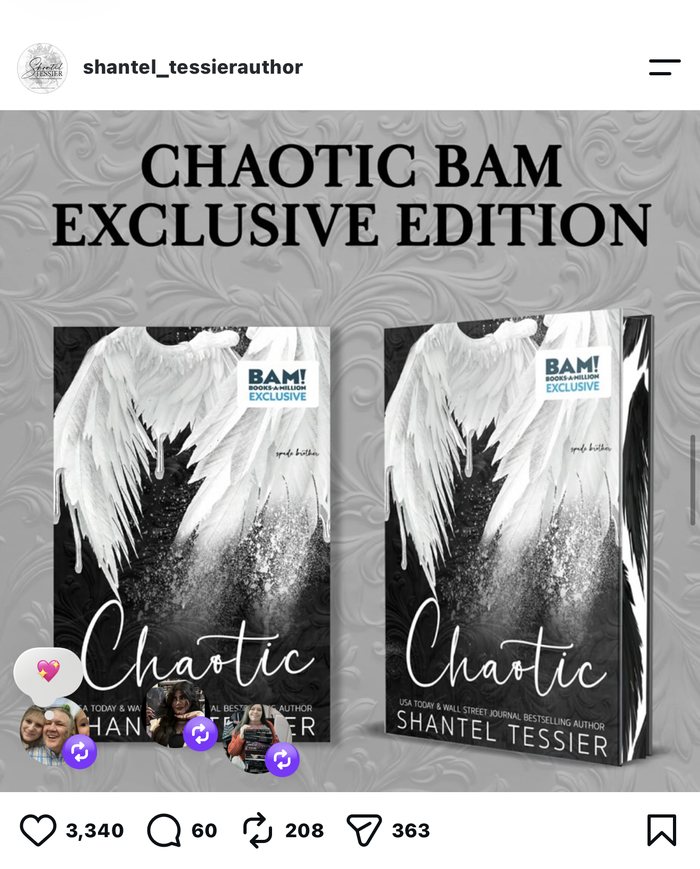
The BAM exclusive edition post is a clean product announcement. Special cover, retailer exclusive, buy it here.
What's persuasive about it isn't the book, because her readers already own the book. It's the word exclusive. A special edition tells a reader that owning it marks them as a particular kind of fan, the kind who was paying attention, who got there early, who cares enough to want the nice one.
People don't collect special editions because the story is better. The story is identical. They collect them because owning one says something about who they are.
Notice too that the post never argues for this. It doesn't explain why you'd want a collectible edition. It assumes you already do. That assumption is doing quiet work, because when a message treats a behavior as obvious, the behavior starts to feel normal instead of optional.
What this means for you: if you're doing a special edition, sell what owning it signals, not what's printed on it. Sprayed edges are a feature. Being the reader who has the sprayed edges is the actual product.
2. Production quality is an argument you never have to make out loud
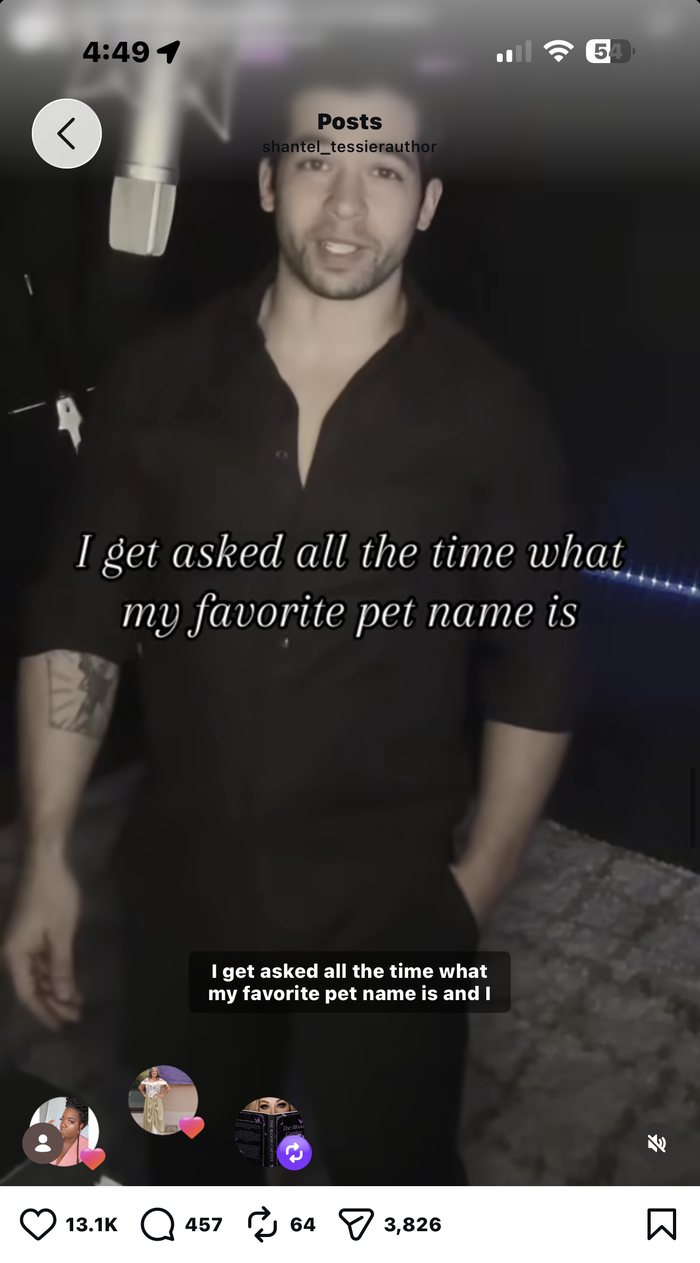
The narrator reel is the highest performing post of the four. It's the audiobook narrator in a studio, real microphone, real lighting, delivering a line straight to camera.
Nothing in it says “this audiobook is professionally produced and worth your credit.” It doesn't have to. The studio says it. The lighting says it. The fact that the narrator is comfortable on camera says it.
This is how most decisions actually get made. People aren't carefully weighing your product's merits. They're reading surface signals and drawing fast conclusions. A polished thirty second video gets a better answer than three paragraphs explaining why the production quality is good, because the video demonstrates it instead of claiming it.
And this one got shared nearly 4,000 times, which is the part authors should really pay attention to. Ads don't get shared. Something people enjoy watching gets shared.
What this means for you: stop describing your quality and start demonstrating it. One well-shot video beats a paragraph of adjectives. This is also why cheap graphics quietly hurt you. Readers read production value as a proxy for everything else, whether or not that's fair.
3. Withholding beats explaining
The teaser post is the one I'd study hardest if I were you. It's a black and white photo of shattered glass and a single line of dialogue: “You missed me. Better luck next time.”
That's it. No blurb. No plot. No release date in the image. No context whatsoever.
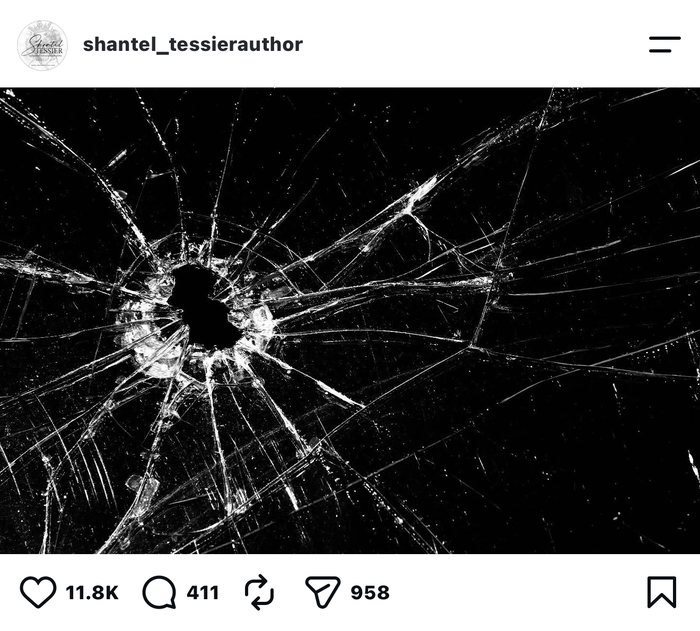
And it pulled 411 comments.
Here's the mechanism. Humans are wired for story, and a fragment of one is more compelling than a summary of one, because the fragment makes you do the work. Who said that? Who were they talking to? Somebody just shot at somebody and missed. Every reader who sees that line starts building the scene in their head, and the second they start building, they're invested. They're not receiving your marketing anymore. They're participating in it.
The image is doing the second half of the job. Shattered glass means violence, danger, something broken. Nobody has to explain that. A dark romance reader sees that image with that line and instantly knows the tone, the genre, and whether this book is for them. Two elements, and the whole positioning is handled.
Compare that to the average author teaser, which is usually three paragraphs of setup, a full blurb, buy links, and a release date. That post answers every question. And a post that answers every question gives the reader nothing to do.
What this means for you: your teasers are probably too long and explaining too much. Pull a single line that raises a question and pair it with an image that carries the tone. Then stop. The restraint is the technique.
4. Being reachable is a strategy, not a personality trait
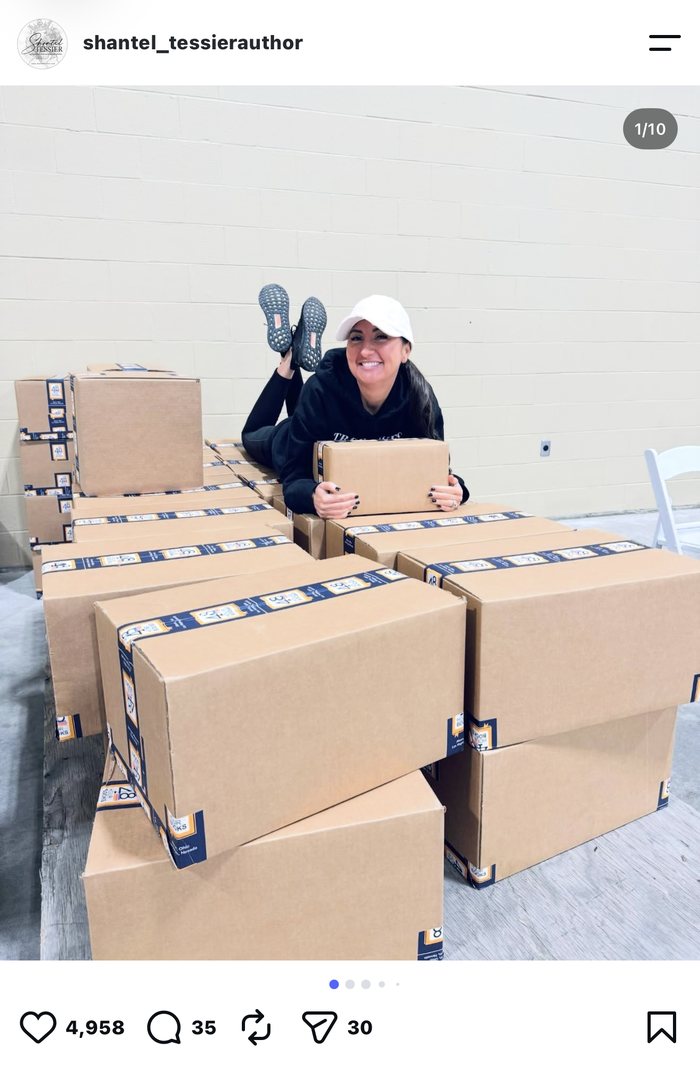
The signing post is the author lying across a wall of shipping boxes at an event, grinning at the camera in a hoodie and a ball cap.
Look at what that image manages to do at once. The boxes are evidence: this is a lot of books, there's real demand here, this is a working author with a real career. But she's not posed in front of them looking accomplished. She's draped over them like a goofball.
That combination is the entire point. Success plus approachability. The boxes establish that she's the real deal, and the pose removes any distance that might have created.
What it builds is the sense of a relationship. Her followers feel like they know her. They don't, not in any two-way sense, but the feeling is real and it's what turns a person who liked a book into a person who buys everything you release and defends you in the comments. That feeling is built through exactly this kind of post, the unpolished behind the scenes moment where the reader gets to feel like an insider.
And notice: this post sells nothing. There's no link, no ask. It still outperformed the exclusive edition announcement.
What this means for you: the posts where you're not selling anything are what make the selling posts work. If your entire feed is covers and buy links, you're asking for transactions from strangers. Put yourself in the feed. Let people see the boxes and the bad hair day.
Why the whole thing works, which is the actual answer
Here's what I'd want you to take from this. No single one of those posts is the campaign. The campaign is the fact that they run together, constantly, in the same voice.
The teaser builds anticipation. The reel demonstrates quality. The signing post builds intimacy. The product announcement converts all of it into a sale. Pull any one out and run it alone and it underperforms, because a product announcement with no anticipation behind it is just an ad, and an ad from an author nobody feels close to is easy to scroll past.
Most authors I talk to are doing one of those four things. Usually the product announcement, because it's the one that feels like marketing. Then they wonder why the announcements don't convert. They don't convert because there's nothing underneath them.
That's the difference between posting and having a strategy. Not effort. Structure.
What this looks like when I do it
I want to give you a real example, because it's easy to point at a bestselling author and say “do that.”
I took over newsletter management for an author whose list had been sitting flat between 500 and 600 subscribers for about four months. By the time I handed it back, it was approaching 900.
But the growth isn't the number I'm proudest of. In one reporting stretch, new signups were actually slightly lower than the period before. What changed was unsubscribes, which dropped by roughly 45%, nearly cut in half. Net growth went up while raw signups went down.
That's the same principle as everything above. I wasn't chasing volume. I was fixing who was arriving and why they stayed. A subscriber who joins because they connected with something real is a subscriber who's still there on release day. A subscriber who joins for a giveaway is gone in a month and you paid for them anyway.
Reach is the number everybody quotes. Retention is the number that shows up in your royalties.
Where most authors get stuck
Almost nobody I work with has a content problem. They have a system problem.
They're posting when they remember to. Their teasers explain too much. Their graphics don't match each other, so nothing accumulates into a recognizable brand. They go quiet for three weeks and then post four buy links in a row. Every individual piece might be fine, and the whole thing still doesn't build.
The authors whose marketing looks effortless are running a structure. Somebody decided what goes out, in what order, in what voice, and how each piece sets up the next one.
That's the work. It's less glamorous than a pretty graphic and it's the reason the pretty graphic performs.
And credit where it's due: this campaign is a genuinely good piece of work. If you want to see the rest of it, she's at @shantel_tessierauthor, and you can find her books here.
If you want help with this
This is what I do. Marketing and content strategy for romance authors: campaign planning, content calendars, teaser and graphic systems that actually look like they belong together, newsletter management and growth, launch strategy, and social content built to work as a system instead of a pile of one-offs.
I also handle the surrounding pieces when authors need them: author websites, branding and brand kits, cover design, and ongoing PA support. Plenty of my clients start with one thing and add others once the first is running.
If your marketing feels like a lot of effort producing not much, that's usually a structure problem and it's fixable. Send me a message and tell me what you're working on.